
The SCARF model - a cheat sheet for Human Behaviour

David Mernagh • October 21, 2026

SCARF: The five social triggers that instantly change how people think, feel, and act.
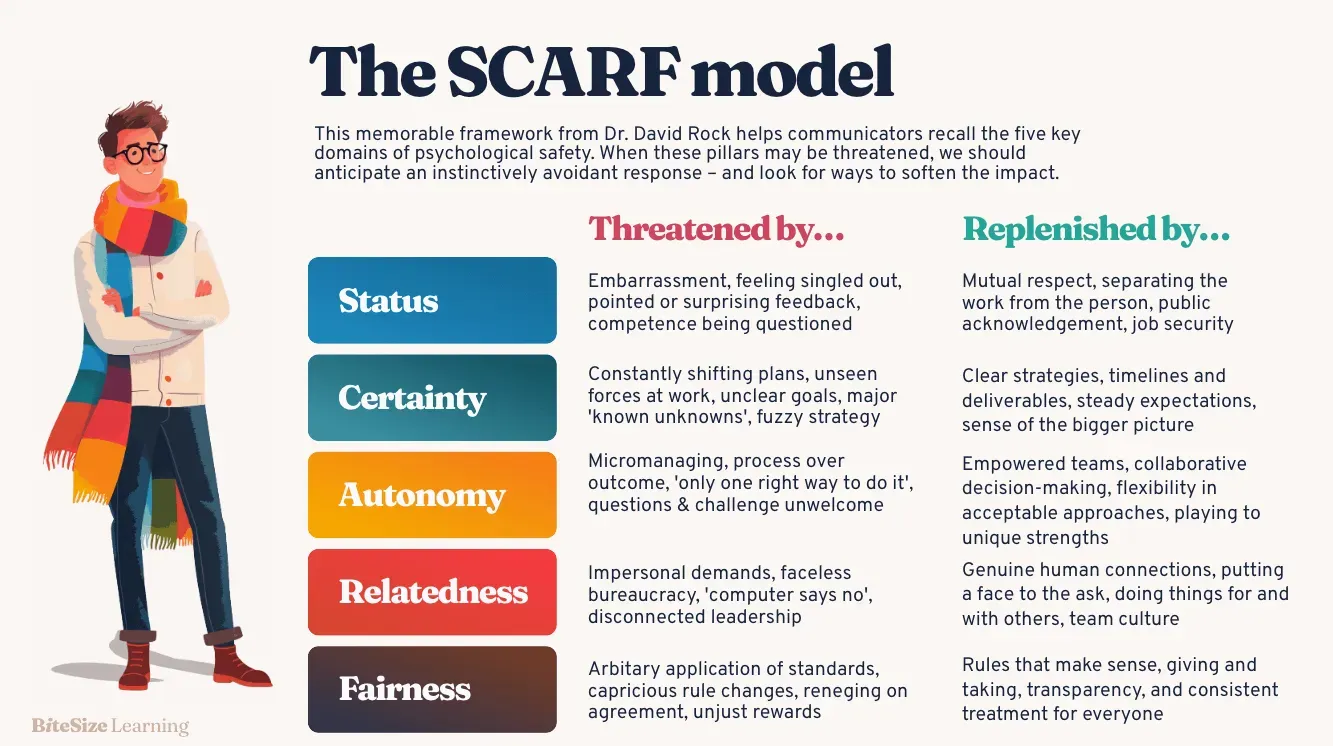

The SCARF model gives you a cheat‑sheet for human behaviour, revealing the five triggers that instantly shape how people react, collaborate, and perform. By revealing the five social triggers that drive human behaviour, it helps you reduce friction, build trust, and create interactions where people feel safe, motivated, and ready to engage.


Created by Dr. David Rock in 2008, the SCARF model is a neuroscience-based framework that outlines five social domains driving human behaviour.


The 5 SCARF Domains

  • S - Status: Your relative importance, worth, and position compared to others.
  • C - Certainty: Your ability to predict the future and expect clear outcomes.
  • A - Autonomy: Your sense of control and choice over your own actions and environment.
  • R - Relatedness: Your sense of safety, trust, and connection with a group (friend versus foe).
  • F - Fairness: Your perception of just, honest, and equitable treatment between people.


In the workplace, this explains why things like ‘giving & receiving feedback’ and ‘managing change’ can sometimes generate strong adverse reactions. By keeping this model in mind, we can anticipate how our actions and communications might provoke emotional responses in others, and take steps to mitigate these.


Click here for a presentation pack that covers the 5 SCARF Domains.


Keen to learn more, click here The SCARF Model by David Rock, explained | A framework for leading others + change management — BiteSize Learning

By David Mernagh • October 31, 2026
“Learn – Experiment – Refine – Grow”
By David Mernagh • October 12, 2026
Keeping in mind AI affects industries differently!
By David Mernagh • October 11, 2026
Traversing the uncharted waters of an AI future
By David Mernagh • October 8, 2026
A summary of the Change Management Institute’s new research on the emerging Futures of Change Towards 2035
By David Mernagh • September 22, 2026
Change is easier to manage when you can see it. The Prosci ADKAR Model breaks change into five observable elements: Awareness, Desire, Knowledge, Ability and Reinforcement, so leaders and practitioners always know where progress stands and where it needs support. This is the practical framework successful companies use to help people adopt and sustain change. Click here to access this article via the Prosci web site.
By David Mernagh • September 22, 2026
Stakeholder engagement is essential to executing strategy and driving business performance. When leaders engage stakeholders (employees, customers, communities, investors, and other groups), they build trust, foster collaboration, and improve decision-making. Prioritizing stakeholder engagement strengthens relationships, increases transparency, and accelerates sustainable growth for the business. Click here to access this article via the Prosci web site.
By David Mernagh • August 3, 2026
Perfect change projects may fail if we don't look at the organisational subconscious so we can understand what is really happening. Click here to access this blog via the Change Management Institute web site.
By David Mernagh • August 3, 2026
The question at the heart of this session is a simple one: do frameworks give us better outcomes, or do they just give us a structure? Click here to access this blog via the Change Management Institute web site.
November 13, 2020
Extracts from “2018-19 Lessons Learned Report for ICT-enabled Initiatives”
November 13, 2020
Enterprise Risk Management (ERM), as a credible and valued business activity, has gained currency in recent years and is now widely accepted.